HOW WE COMPARE
How to choose an attack surface management tool
Every external attack surface management vendor claims continuous discovery, prioritised risk and a single view. Explore what separates them and where we fit. Put us to the test, with engineer support during your trial to help you compare results.
Make sure you are comparing the right thing
Four different classes of tool get put on the same shortlist. They answer different questions, and most mature teams end up with more than one.
THIS CATEGORY
External attack surface management
Show a live inventory and the exposure attached to it when a client, prospect or panel asks how you manage your estate.
ADJACENT SERVICES
Vulnerability scanners
Test the scope you point them at, often including internal networks, and usually go deeper on a known host. They cannot find the asset that is missing from your inventory.
ADJACENT SERVICES
Penetration testing
A skilled human attempts to break in against an agreed scope at a point in time. Deeper than any automated tool, and complementary rather than competing.
ADJACENT SERVICES
Security rating services
Score your organisation, and often your suppliers, for an outside audience. Useful as a signal, but a grade with limited working shown is hard to act on.
Seven questions worth asking any vendor
Including us. If a vendor cannot answer these plainly, that is itself an answer.
Where does our data live?
Sovereignty matters for regulated work and for public sector procurement. Ask where the platform is hosted, who operates it, and who could be compelled to access it.
OUR ANSWERHexiosec ASM is designed, hosted and operated in the UK.
Is discovery non-intrusive?
Active scanning can need a change window and can disrupt fragile services. Ask exactly what the tool sends to your systems.
OUR ANSWERDiscovery is non-intrusive and uses publicly available information only.
How is risk prioritised?
Severity alone produces noise. Ask whether real-world exploitability data informs the ordering, and whether you can see the reasoning.
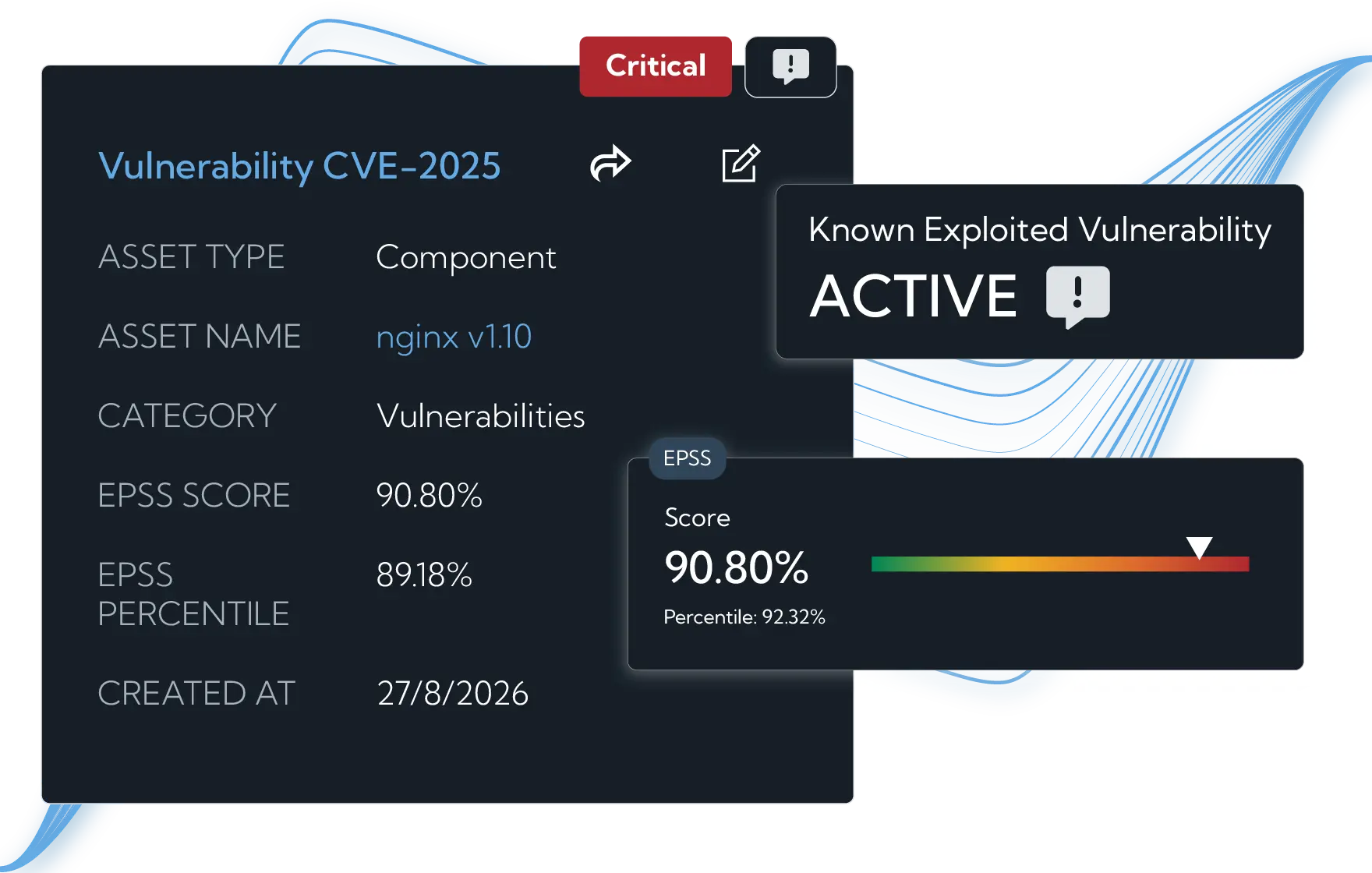
OUR ANSWERThe CISA Known Exploited Vulnerabilities (KEV) catalogue and the Exploit Prediction Scoring System (EPSS) lead the ordering, with the evidence shown.
Can we try it without talking to sales?
A vendor confident in the product will let you see output before a call. A mandatory discovery call usually protects the price, not you.
OUR ANSWERFree scan with no account, plus a free tier that does not expire.
Is the product pricing published?
Unpublished pricing generally means the number depends on what they think you will pay. Ask for the list price and the renewal uplift.
OUR ANSWERPublished tiers, with Enterprise scoped to your estate.
Who answers when it matters?
Ask who you actually reach: an engineer who knows the product, or a first-line queue reading a script.
OUR ANSWERDirect access to the engineers who built it.
What happens when you need something it does not do yet?
Ask where a feature request actually goes, how often requests ship, and whether the result is locked to the tier above the one you are on.
OUR ANSWERRequests reach the engineers who build the product. Some ship within weeks, and they land on every tier that can use them.
Hexiosec ASM against the usual alternatives
Written by us, so treat it as a starting point rather than an independent review. Every line here is something you can verify yourself.
| Hexiosec ASM | Enterprise EASM platforms | Security rating services | Point tools and free scanners | |
|---|---|---|---|---|
| Data residency | UK sovereign | Usually US or EU hosted | Usually US hosted | Varies, often unclear |
| Discovery method | Non-intrusive, no agents | Mixed, often active | Limited depth | Single-purpose checks |
| What you see | Assets and findings | Assets and findings | A score and summary | One check at a time |
| Prioritisation | KEV and EPSS led | Varies by platform | Proprietary weighting | Severity only, if any |
| Try before buying | Free scan and free tier | Sales-led evaluation | Sample report | Free but shallow |
| Pricing | Published | Quote on request | Quote on request | Free or low cost |
| Supplier monitoring | From the free tier | Often a separate module | Core to the model | Not available |
| Support model | Direct access to engineers | Tiered support contracts | Account management | Community or none |
| Feature requests | Reach the engineers, often shipped in weeks | Enterprise roadmap process | Not applicable | Community requests |
| New capability | Released to every tier that can use it | Often a paid add-on or upper tier | Bundled into the score | Rarely added |
| Best suited to | UK regulated organisations | Very large global estates | Portfolio-level oversight | One-off spot checks |
Sovereignty is a procurement question, not a marketing one
For UK public sector, legal and financial work, where the platform runs decides whether it can be bought at all. Hexiosec ASM is British built, British hosted and British operated, by engineers from government, defence and intelligence backgrounds.
- Designed, hosted and operated in the United Kingdom
- Available through the Government Commercial Agency and G‑Cloud 15
- Cyber Essentials Plus and JOSCAR registered
- No transfer of your estate data outside the UK
Anyone can list findings. Ordering them is the hard part.
A tool that returns four hundred issues without telling you which twelve matter has moved the problem rather than solved it. We lead with what is being exploited in the wild, and show the evidence so your team can challenge it.
- The CISA Known Exploited Vulnerabilities catalogue flags what is actively exploited
- EPSS estimates near-term exploitation probability
- Exposure and asset context sharpen the ordering
- Grouped actions so one fix closes many findings
Where you may need more than Hexiosec ASM
We focus on external exposure. We will be clear about what we cover and where other tools or services fit alongside us.
You need internal network scanning
Hexiosec ASM is external by design. For systems inside your network, use internal vulnerability scanning alongside us.
You want offensive testing
We identify exposure without exploiting it. Penetration testing or red teaming adds adversarial assurance alongside us.
You need managed detection and response
We show what is exposed. For live endpoint monitoring and incident response, use a SOC or MDR service alongside us.
You want a single global vendor for everything
We scan large, complex estates. A single vendor can simplify procurement, but EASM may be an add-on. Compare results on your own estate before choosing.
How to run a comparison that actually tells you something
Vendor demos are rehearsed. The only test worth doing is against your own estate, with the same inputs given to everyone.
Use your real domain
Give every vendor the same seed and compare what each one finds. Demo tenants are chosen because they look good.
Check the attribution
Look at what each tool claims is yours. Over-attribution inflates the numbers and your bill. Ask how you exclude things.
Compare the top ten
Ignore total finding counts. Ask each tool what you should fix first, and judge the reasoning behind the answer.
Ask about renewal
Establish the year two price, the uplift, and what happens when your estate grows, before you sign anything.