Risk management
Attack surface monitoring and risk prioritisation
Fix what attackers are actually exploiting. Not every vulnerability deserves your Tuesday. Hexiosec ASM ranks exposure by real-world exploitability, groups related findings into actions, and tracks each one to closure.
- KEV and EPSS scoring
- Grouped into actions
- Tracked to closure
A ranked worklist changes what your team can achieve
Prioritisation decides whether a small team makes real progress or spends the month on findings nobody was going to exploit.
WORK SMARTER
Get through remediation without adding headcount
Related findings are grouped by root cause, so one fix can close several findings and a small team can hold a large estate.
PASS ASSESSMENTS
Evidence vulnerability management for your framework
CAF, NIS2, DORA and DSPT all expect risk to be identified, prioritised and demonstrably acted on.
IMPROVE RENEWALS
Answer insurer questions about exposure honestly
Underwriters ask what you found and what you fixed. Show both, with dates against them.
MANAGE SUPPLIERS
Prioritise supplier issues alongside your own
Apply the same exploitability lens to the third parties who hold your data.
Built for teams who cannot fix everything
The IT lead facing a wall of findings
You need to know which ten things to do this month, not just which four hundred exist.
The security lead defending priorities
You are asked why one issue was fixed before another. You need data behind the answer.
The risk or compliance lead
You have to evidence that vulnerabilities are identified, ranked and remediated on a cycle.
Severity alone tells you very little
A critical score on an unreachable host matters less than a medium on your public login page. Severity describes the flaw. It says nothing about your exposure.
Too many findings
Raw output overwhelms small teams and buries the handful of issues that actually matter.
No business context
Scores ignore whether an asset is exposed, business critical, or already being attacked in the wild.
No route to done
Findings without grouping, ownership or tracking never become fixes you can evidence.
Continuous assessment across the whole estate
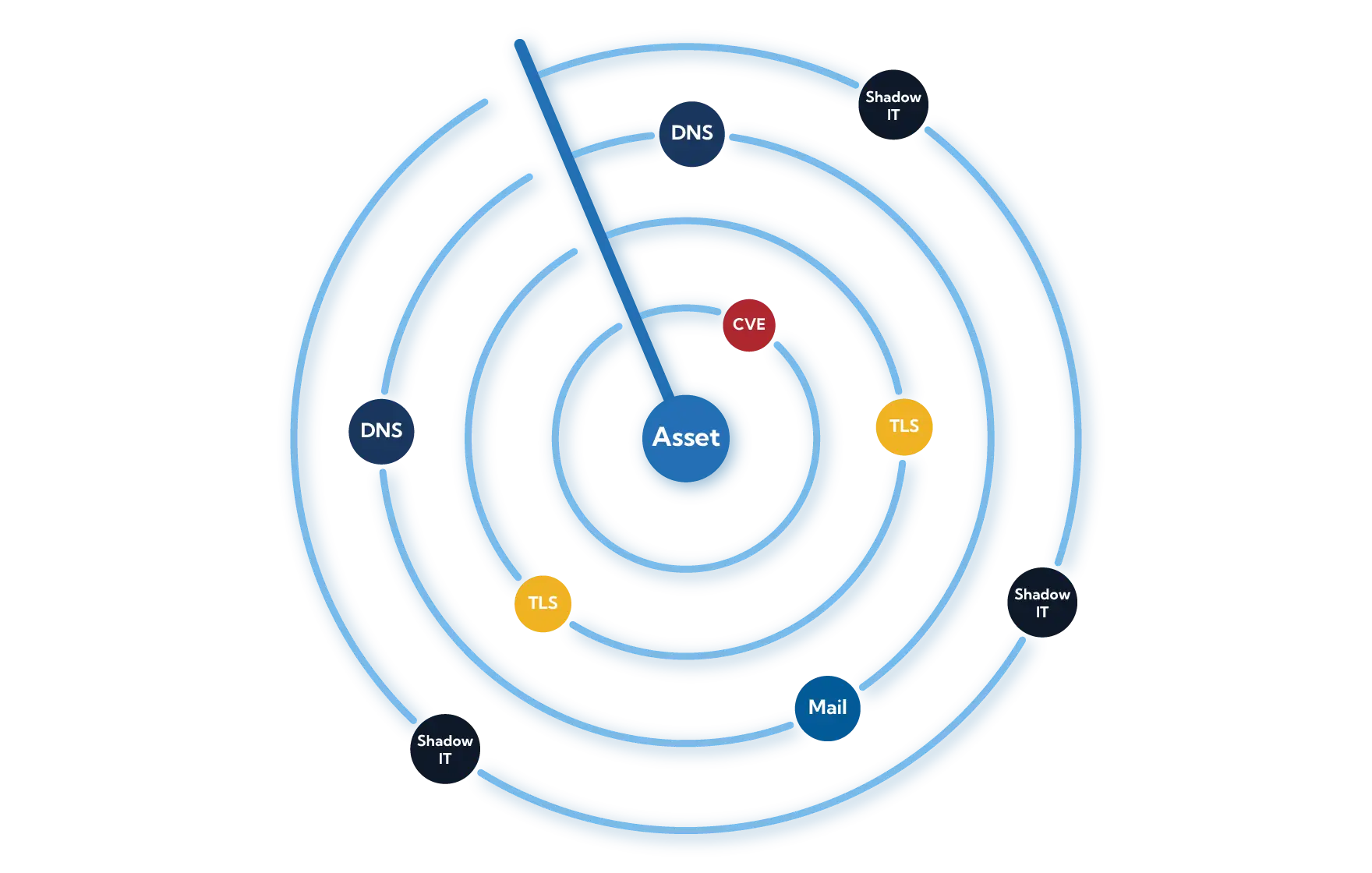
Discovered assets are assessed for security weaknesses and exposure using non-intrusive techniques designed to avoid disrupting your systems.
- Common Vulnerabilities and Exposures identification on fingerprinted services
- TLS, certificate and protocol weaknesses
- Mail and DNS misconfiguration
- Exposed panels, legacy hosts and risky services
Exploitability first, not severity theatre
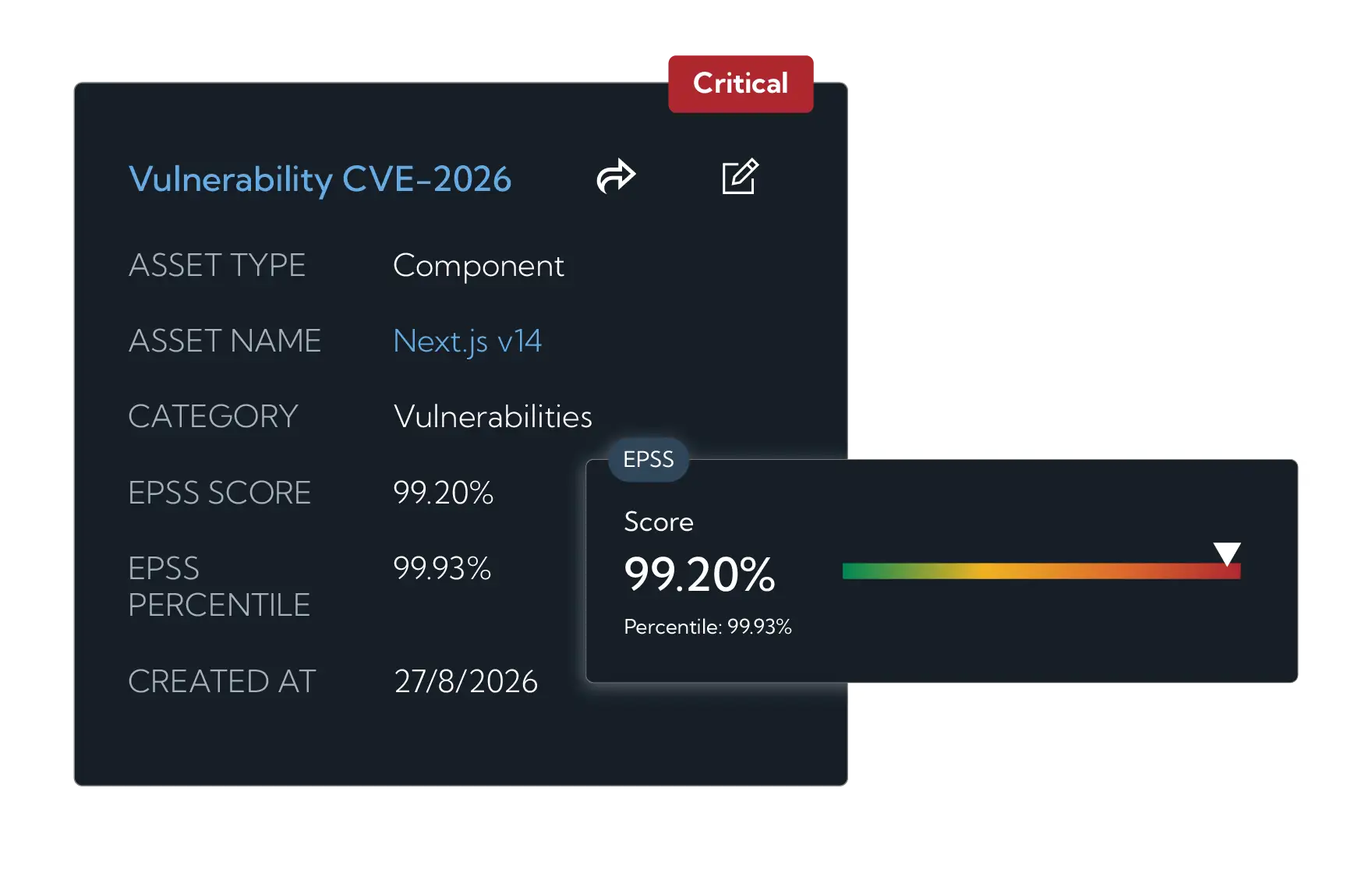
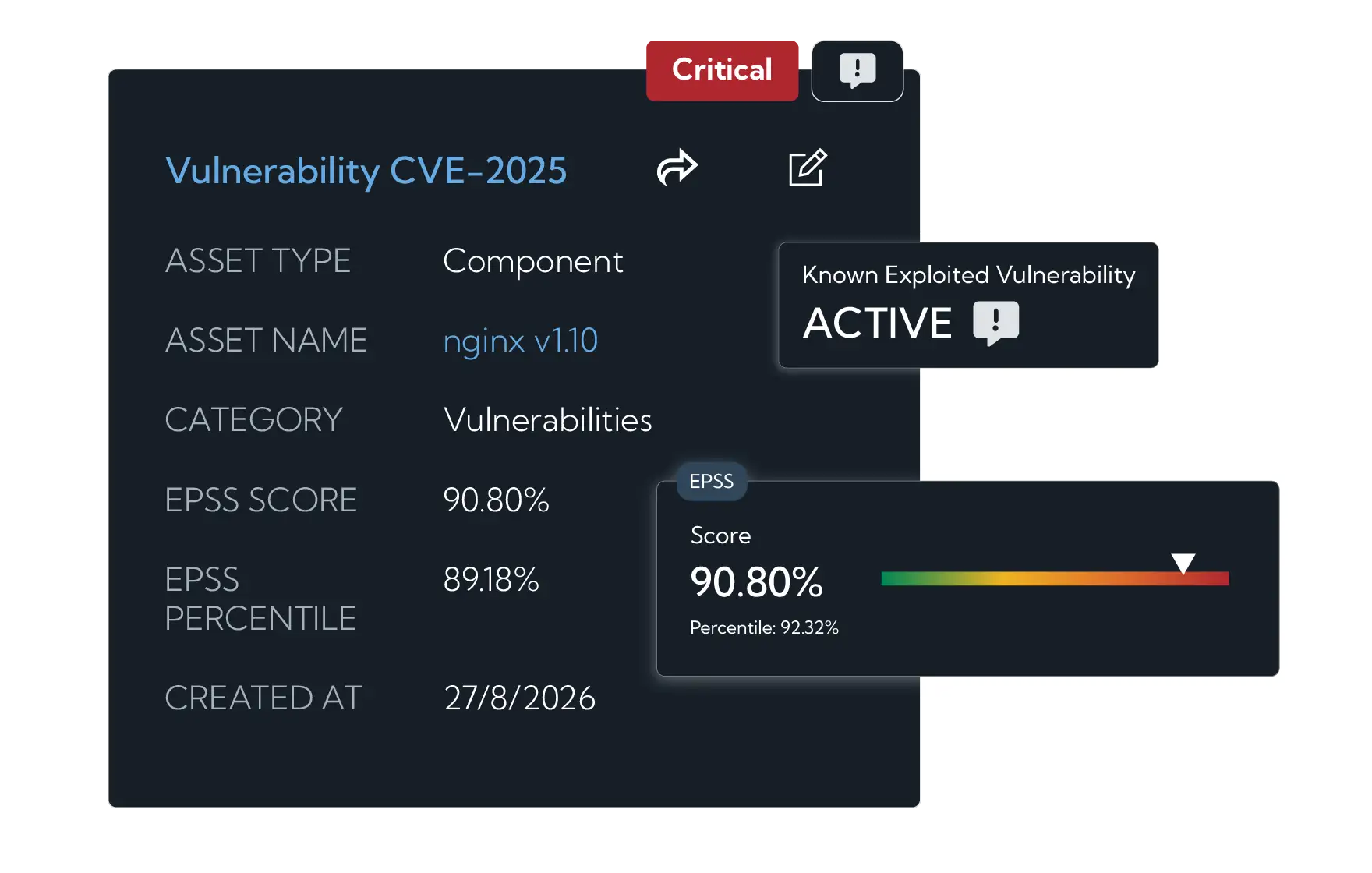
Findings are enriched with CISA KEV and EPSS, so you can separate what has known exploits and is exploitable from what merely scores highly.
- CISA Known Exploited Vulnerabilities (KEVs) flagging
- Exploit Prediction Scoring System (EPSS) probability scoring
- Exposure and asset context
- Your own tagging and business criticality
An action plan, not a wall of findings
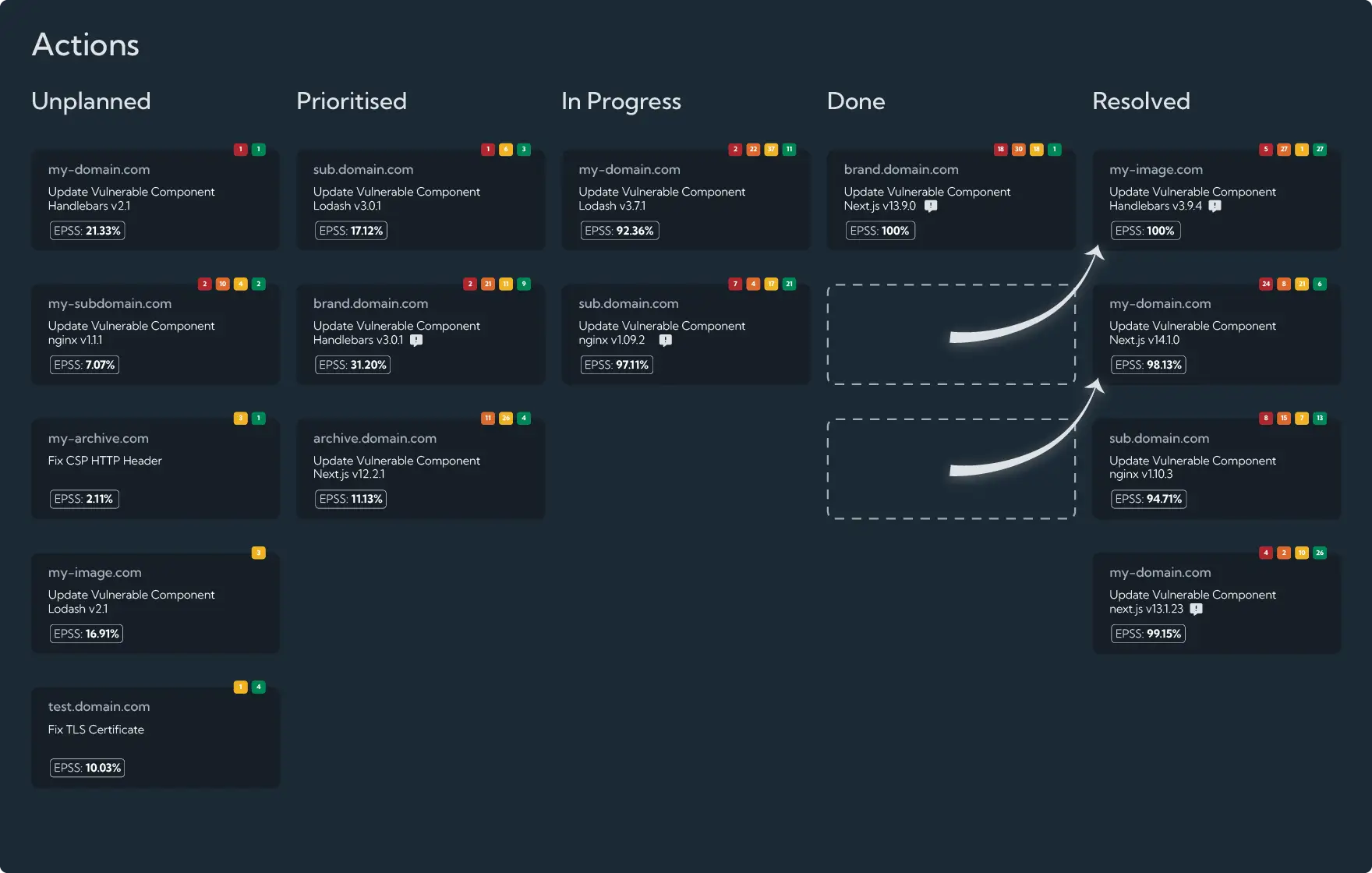
Related findings are grouped by root cause into actions with remediation guidance, so work can be assigned, tracked and evidenced.
- Actions grouped by root cause, so one fix closes many findings
- Remediation guidance in plain language
- Ownership, status and progress tracking
- Move it to ‘done’ when a fix has been applied
- Actions update to ‘resolved’ when the risk is no longer present
- A closure trail you can show an auditor
How risk is calculated
We combine what we can observe about your estate with public exploitability data. Nothing below requires credentials or an agent.
Service fingerprinting
Findings begin with what a service actually is and which version it reports, rather than an assumption.
CISA KEV enrichment
Vulnerabilities on the CISA Known Exploited Vulnerabilities catalogue are flagged, because active exploitation outranks theory.
EPSS probability
The Exploit Prediction Scoring System estimates the likelihood of exploitation in the near term, so you can rank what is not on the KEV list.
Exposure context
Add tags to your asset to provide business context that can help to prioritise remediation efforts.
Non-intrusive verification
We confirm through observation rather than exploitation, so nothing we do can disrupt a production service.
Closure re-checks
Fixed risks are reassessed on the next cycle, so you can validate the remediation.
The problems a ranked worklist solves
Risk management is the engine behind several of the outcomes our customers are measured on.

asm led
Achieve compliance
Evidence that vulnerabilities are identified, prioritised and remediated on a defined cycle.

ASM Led
Cyber insurance readiness
Show underwriters a controlled remediation process rather than an unquantified estate.

ASM + Transfer
Third-party & supply chain risk
Rank supplier exposure and decide which relationships need a conversation.

ASM + Transfer
M&A due diligence
Quantify the remediation cost of a target estate before the price is agreed.
What prioritisation looks like in your sector

Legal
Client data exposure and the estate inherited through mergers, evidenced for Lexcel and client audits.

Wealth and asset management
DORA ICT risk duties and the sprawl that follows consolidation.


Seen the problems. Now get help fixing them.
Finding and ranking risk is the easy half. Our consultants work with teams who need a remediation plan they can actually resource, or an architecture fix so the same issues stop returning.
- Remediation planning and prioritisation alongside your team
- Infrastructure and architecture review where the same issues keep returning
- Migration and hardening support for legacy services
- Governance and process development so the estate stays controlled

What I appreciate the most about Hexiosec ASM is the level of accuracy this platform provides while maintaining a non-intrusive approach to data collection. Hexiosec's unique solution provides results that are immediately accurate and actionable.

Risk management across the tiers
Detection and scoring are included everywhere. Workflow depth and cadence change as you move up.
Core risk views
Findings, severity and exploitability scoring across up to 50 assets, refreshed weekly.
Full workflow
Daily assessment, grouped actions, tagging and downloadable reports across up to 300 assets.
Workflow at scale
Estate-wide coverage, API access, ad hoc scanning and a named account manager.
Questions we get asked about risk management
What are KEV and EPSS?
Do you exploit vulnerabilities to confirm them?
How do you handle false positives?
Does this replace penetration testing?
Can findings feed our ticketing system?
How quickly are new vulnerabilities reflected?
See what would top your list
Create a free account and we’ll show you the exposure ranked by what is actually being exploited.